

Is $4/litre inevitable?
or, in other words, are we being screwed?

TLDR: The situation as at 24 March 2026
world price of crude oil = US$100/barrel
exchange rate NZ$1 = US$0.588
the NZ$ price of crude oil = NZ$170/barrel
In line with the average relationship of the past 27 years, the retail price of petrol in New Zealand at this point in time should be around $2.86/litre.
However, the GASPY average for 24 March was reported as $3.36/litre - ie. 50 cents, or nearly 17.5%, higher than implied by the average relationship.
What gives?
While not conclusive, the quantum of this departure from the average relationship of the past 27 years provides a prima facie case for officials to pursue the industry to extract a suitable explanation.
Crude oil and petrol prices - the historical experience
The following data was assembled.
quarterly data on the retail price of petrol (91 octane) from Tatauranga Aotearoa Statistics New Zealand (INFOS series CPIQ.SAP0710)
monthly data on the world price of crude oil (West Texas Intermediate) from the Federal Reserve (Economic Data Series MCOILWTICO)
monthly data on the NZ$/US$ exchange rate from the Reserve Bank of New Zealand - Te Pūtea Matua
The information - with the monthly series converted to quarterly averages - from the December 1998 quarter through to December 2025 is depicted in the chart. The chart suggests (by eye) a reasonable relationship between the NZ$ price of crude oil and the retail price of petrol.
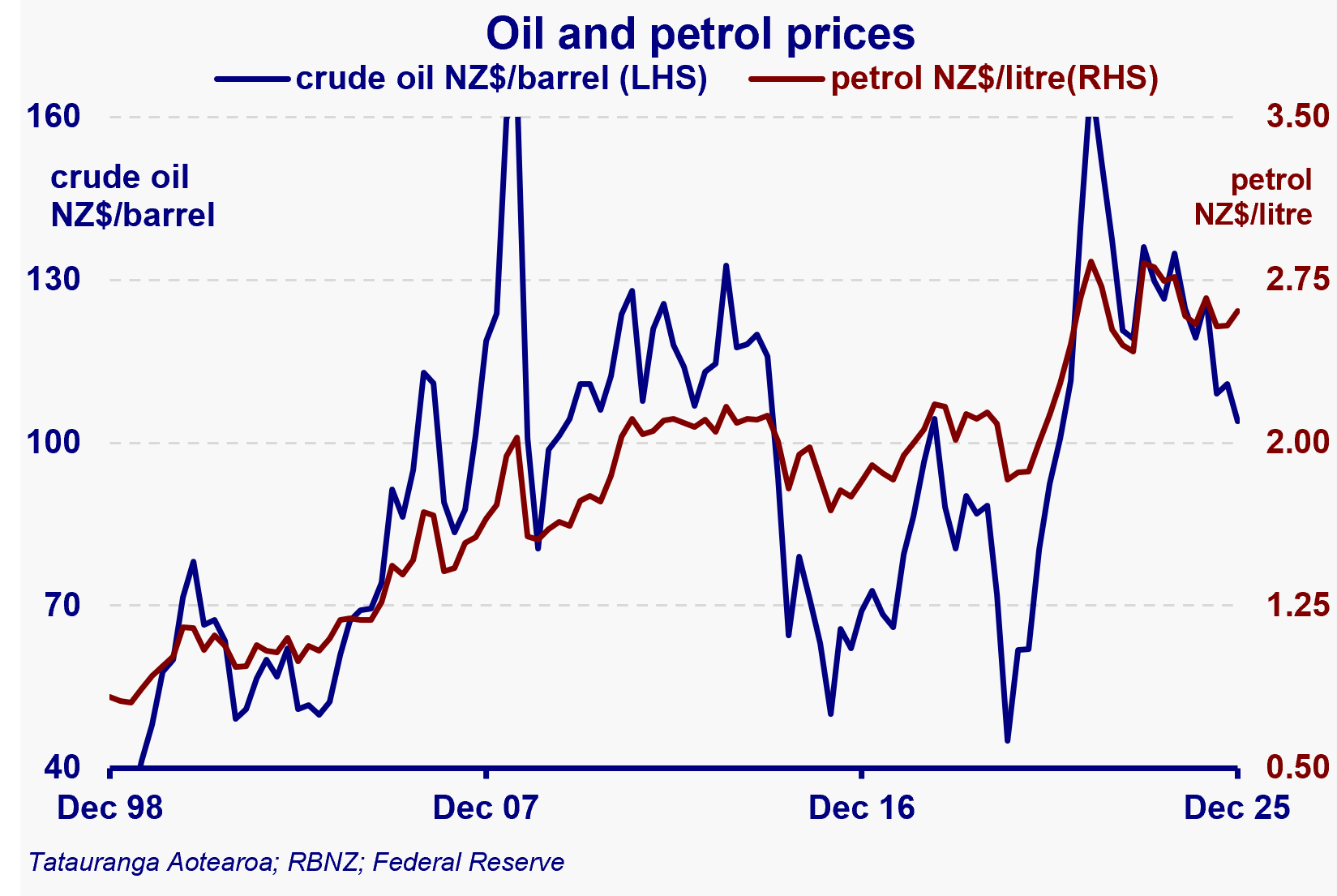
Interestingly, the mid-2008 saw crude oil prices in the early stages of the GFC move “off the charts”, but the full extent of this spike did not appear to be fully reflected in the increases in the retail price of petrol. Conversely, the 2015-2017 period witnessed large declines in crude oil prices, which were seemingly only partially reflected in reduced retail petrol prices.
We could argue about the magnitudes of these shifts, but note both vertical axes are of different scales making such an argument a complex matter. It seems though that the ‘turning points’ in the two prices do - by and large - coincide.
However, there is a notable exception in this - admittedly simplistic - generalisation of the relationship between the two prices. In particular, the latest couple of quarters show noticeable declines in the NZ$ price of crude, contrasting with slightly increasing retail prices for petrol.
So, what gives?
Parameters for the case
Retaining a desire to keep the story as simple as possible for here, the subsequent analysis should not be taken as conclusive. But it does seem to indicate a prima facie (or, “on the face of it”) case for further questions the authorities should pursue.
Illustrating the same information as above, but in a different manner yields the following picture.
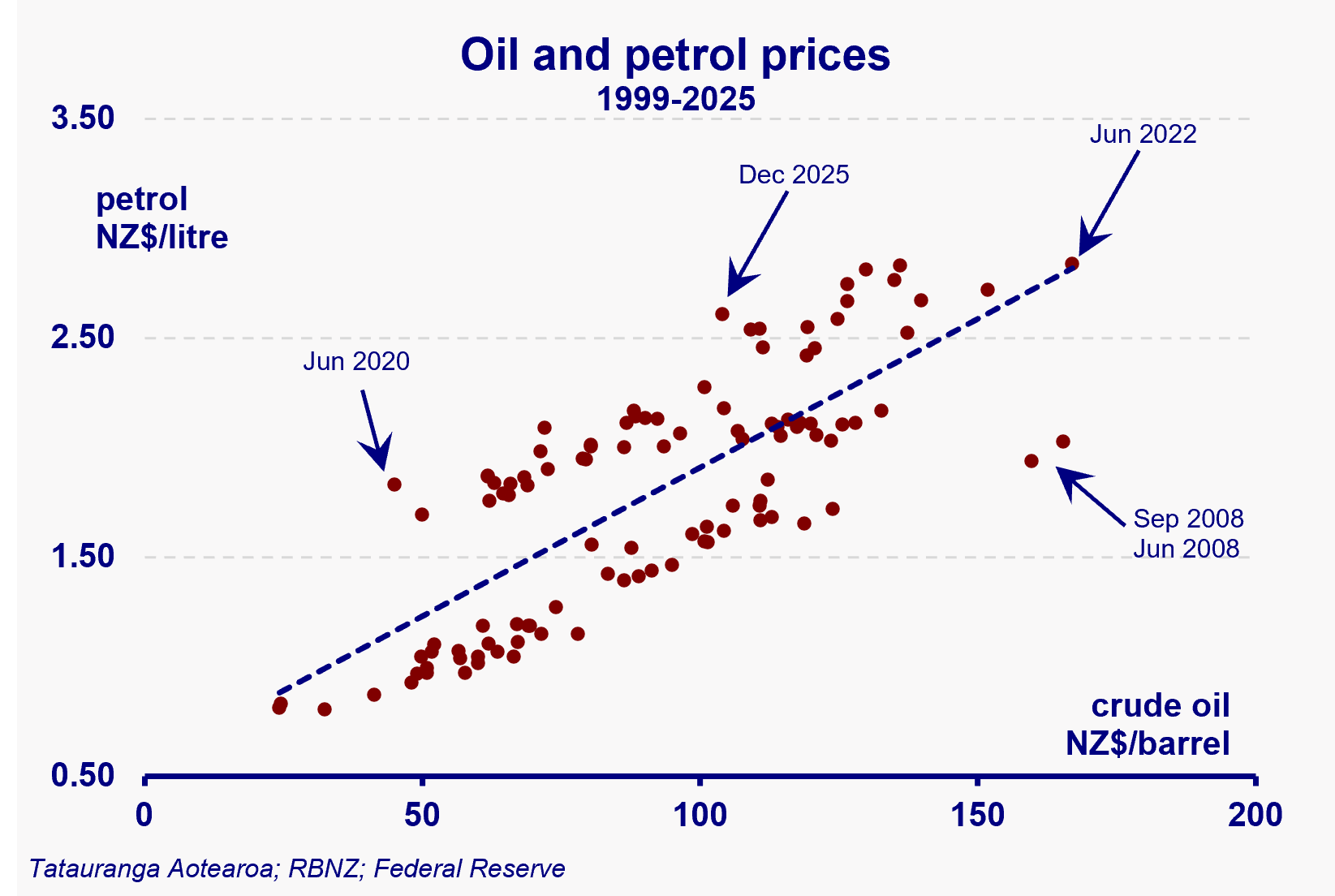
Each of the 109 dots represents the situation for one quarter during the period December 1998 to December 2025. The retail price of petrol is measured along the vertical axis and the NZ$ price of crude oil is reflected along the horizontal axis. The general relationship between the two prices is clear, but (unsurprisingly) not exact.
The upward-sloping dashed line represents the average relationship between the two prices, using the pairs of data over this 109 quarters1. In a sense, the dashed line indicates where the dots would be if the relationship was exact. Alternatively, the vertical distance2 between each dot and the dashed line represents how far away from the average experienced in that particular quarter.
For example, June 2020 (which we could ascribe as being a COVID-related blip) reported crude oil at NZ$45.03/barrel and the retail price of petrol of $1.83/litre. However, the dashed line suggests the retail price of petrol would be $1.16/litre if the average relationship were to be followed.
Conversely, the GFC-related September 2008 quarter reported crude oil at NZ$165.47/barrel with the retail price of petrol at $2.03/litre. However, there would have been a much higher retail petrol of price (of $2.80/litre) were the average relationship to be followed.
Clearly, for the New Zealand consumer, there were wins and losses (the proverbial “swings and roundabouts”) over this period. Some quarters provided relief to the consumer with the retail price of petrol below that implied by the average relationship, while other quarters saw the retail price of petrol well above that implied by the average relationship.
Indeed, none of this is surprising given the nature of any average - ie. there will be, by definition, a number of periods above the average alongside a number of periods below the average.
Outcomes requiring explanation
Of importance for the statistical analyst, and/or the policy advisor, is when there are clear instances where the distance (or variation) from the average relationship is much larger than that of other periods; and/or, where there are sequential periods where the cumulative distance from the average compounds the discrepancy. In addition, where such instances are not fully explicable through association with ‘non-average’ events (for example, COVID or GFC uncertainty).
Of relevance to the current situation is the dot for the latest (December 2025) quarter. This dot indicates that the retail price for petrol was well above that for it to be in line with the average relationship. Specifically, the price of crude was NZ$104/barrel3 with the retail price of petrol being $2.61/litre. However, the average relationship would have expected the retail price of petrol to be $1.96/litre. Indeed, the vertical distance between that December 2025 dot and the dashed line is the 4th largest discrepancy4 over all of the 109 quarters depicted.
An explanation for this large (relative to other quarters) discrepancy in the December 2025 quarter would be a good starting point.
Further, it is noticeable that this discrepancy - or distance from the average relationship - has persisted over the first few weeks of 2026.
For example, and as noted above, the 24 March 2026 situation comprised the price of crude at around US$100/barrel and an exchange rate of NZ$1=US$0.588 translating to the price of crude being NZ$170/barrel. The average relationship suggests a retail price of petrol for 24 March 2026 would be close to NZ$2.86/litre - indeed almost identical to the June 2022 dot in the chart5.
Of course, Tatauranga Aotearoa Statistics New Zealand does not provide daily retail price information. However, the GASPY reports the national average retail price for 91 octane petrol at 3.36/litre. Yes, the data source is different, and so the methodologies may not be comparable. However, both the quantum and the persistence of this discrepancy provide a prima facie case for officials to pursue the industry to extract a suitable explanation for this departure from the average relationship.
And, is $4/litre really inevitable?
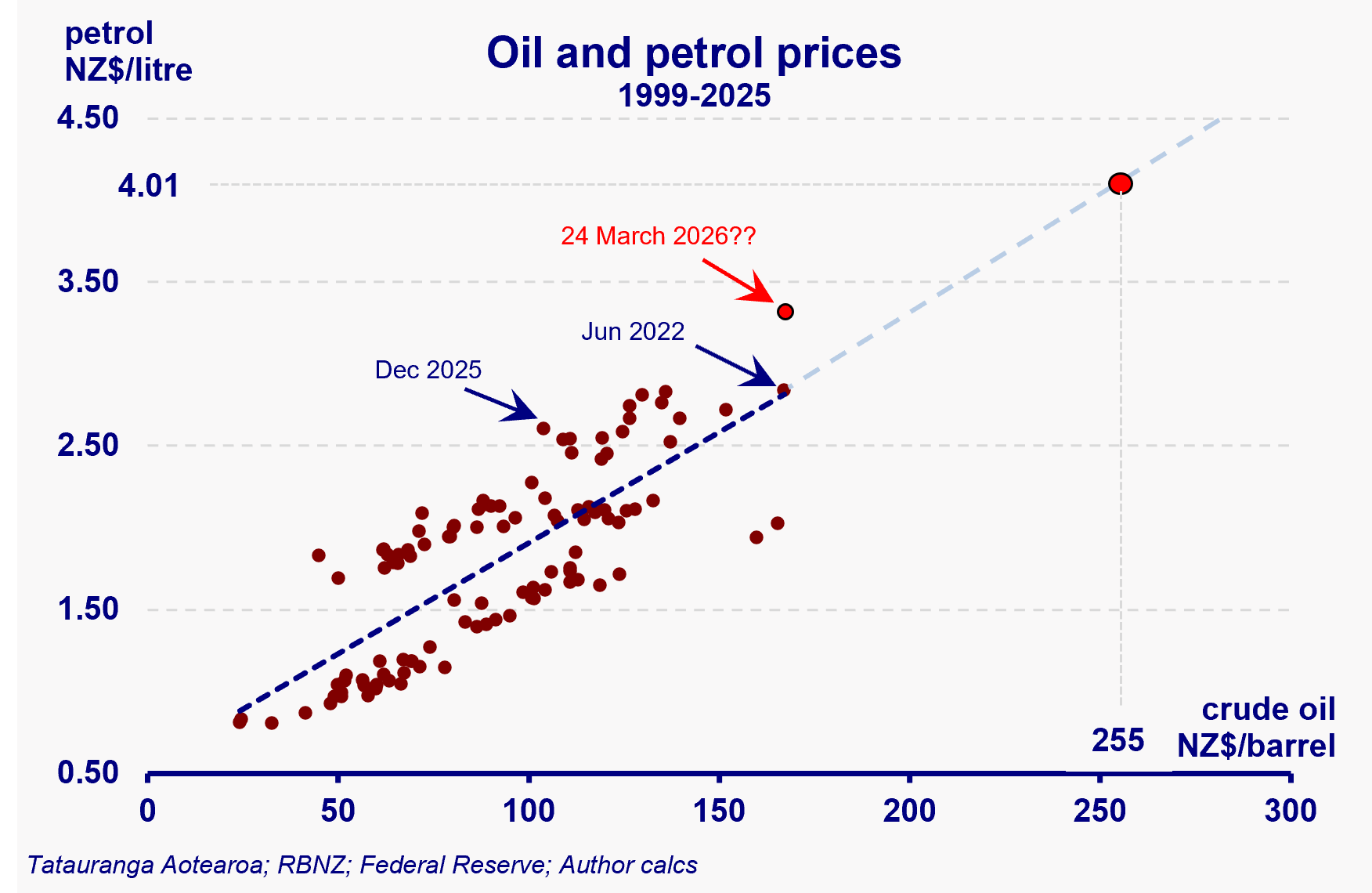
As noted, if the average relationship of the past 27 years was to be followed, the current retail price of petrol should still be well under $3/litre. Further, extending the dashed line, as illustrated, would suggest that the haunting prospect of $4/litre would occur where the price of crude oil was the equivalent of NZ$255/barrel. Two examples (or scenarios) where this situation would arise if
the exchange rate as per currently at NZ$1=US$0.588 alongside a price of crude oil at US$150/barrel
the price of crude oil as per currently at US$100/barrel, alongside an exchange rate of NZ$1=US$0.392
Are we being screwed?
A good question and, as outlined above, the prima facie evidence suggests a good case for - at the very least - an urgent “please explain” to be sent to the industry.
The urgency is in the risk of an inappropriate monetary policy response from the Reserve Bank of New Zealand - Te Pūtea Matua. Increases in interest rates are on the cards where the Reserve Bank sees these retail price increases as triggering further rounds of CPI6 inflation. Noting that petrol comprises 3.5% of the overall CPI calculation - the highest single category outside of new house purchases and rentals - it is imperative that monetary policy decisions are informed by appropriate explanations for the retail petrol price straying noticeably far from its average relationship with the price of crude oil.
However, of (arguably) more importance is addressing the challenge to noticeably reduce our dependence on fossil fuels. I openly acknowledge that many of us do not have the power to avoid the costs of the situation we find ourselves in. But, as opposed to seeking culprits, perhaps it is nigh on time to commit to and rapidly undertake the range of actions required to reduce this dependence?
And while many have said that we should not waste a crisis; I would rather counter with
we should not use a crisis (yet again) as an excuse to delay and defer the long-required overhaul of our energy, transportation, and ancillary systems.
Akin to our COVID experience (who remembers the build back better mantra?), I fear that once again we will continue to reach for excuses to not pick up the wero laid repeatedly in previous years by many in our community.
For those wanting statistical detail, the average relationship is a simple straight-line best-fit of the 109 observations, resulting in an equation:
petrolprice = 0.5511 + (0.01357*crudeprice).
This equation has an adjusted R^2 of 0.6, with both the coefficient on the crudeprice variable and the intercept term being statistically significant.
In statistical terms, the vertical distance between the reported data and the average relationship is known as the residual.
The price of crude was US$59.64, while the exchange rate for the quarter was $NZ1=US$0.573.
Measuring all the discrepancies in absolute terms, where the largest discrepancies were the June 2008 and September 2008 quarters, followed by the June 2020 quarter.
The June 2022 quarter reported the price of crude oil at NZ$167/barrel and the retail price of petrol at $2.84/litre.
Consumer Price Index.