

Is growth the answer?
If so, what is (or was) the question?

Headlines are shouting “growth is back!”
Some 3 months earlier, headlines shouted “growth stalls as economy plunges into recession!”
In both instances the - almost biblical - belief that growth is the solution remained implicit and sadly unquestioned.
Note, in this context the commonly accepted meaning of growth is: increases in measured inflation-adjusted GDP. A definition is in the footnotes1. There are other possible perspectives on, and definitions of, growth. But - for now - please bear with me; the term growth in the commentary below (unless otherwise specifically mentioned) is shorthand for the commonly accepted (but rarely questioned) definition.
Growth is (supposedly) good because
growth means higher incomes
growth means more job opportunities
growth means more houses
growth means stable and resilient supplies of food and energy
growth means more holidays
growth means ability to address stresses on our environment and ecosystems
growth means ability to address mental health, toxic stress, and addiction harms
growth means ability to afford nice stuff.
Or, so I am told.
But, really?
But, and yes call me cynical, being told that growth will deliver these outcomes just sounds way too close to trickle down - or its sibling equivalent a rising tide lifts all boats - for my liking. And, thankfully, there are decreasingly few who buy that story. But, even the disbelievers - sadly - continue to buy, unquestioningly, the growth is the answer narrative. Assessing who were/are/is
best economic managers
or, managing the books prudently
or, a safe pair of hands
or, trusted to fix the economy
sadly sees the latest growth figures quoted and compared to those of some other period (selective dates) to prove the desired point. The (again implicit) narrative being that we don’t have (enough) growth (yet) and we just need (more of) it. Consequently, the policy intervention (or regulation, or government, or party, and/or coalition) that will deliver growth will be our saviour.
The growth experience
Curiously, the data seems to indicate that we have actually recorded reasonable growth over a lengthy period of time. Over the last 40 years (i.e. 1985 to 2025) growth has averaged 2.4% per annum. Over the same period the population of Aotearoa has increased from 3.3 million to 5.3 million - or about 1.2% per annum.
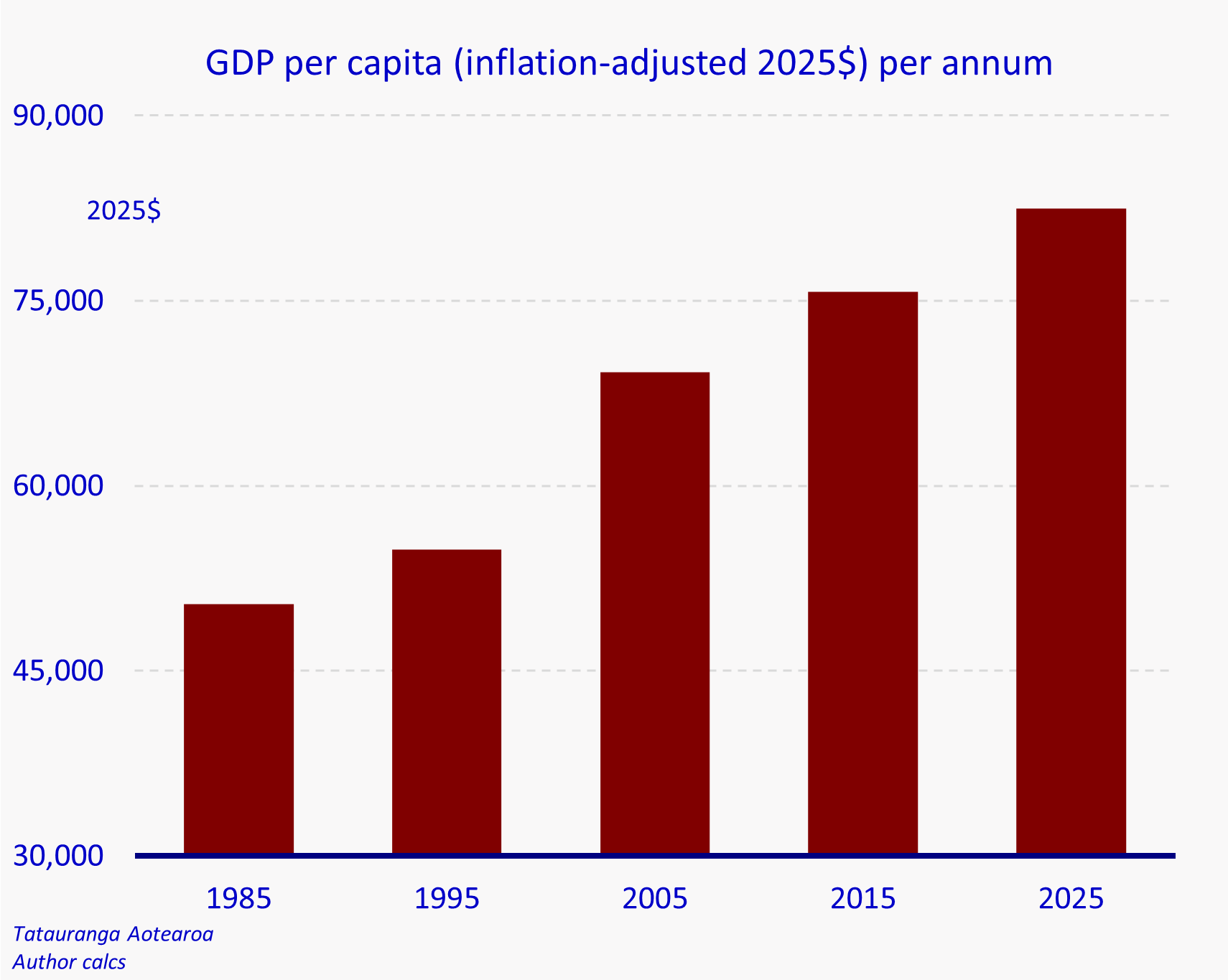
So, per head, we’ve experienced growth of the equivalent of 1.2% every year for 40 years2.
But, given this experience of 40 years of growth, we are left with
many not experiencing higher incomes
minimal (or unattractive) job (or career) opportunities
visibly increased homelessness
sustained food insecurity and energy poverty
better holidays for the few, but not for all
increased stresses on our environment and ecosystems
increased mental health, toxic stress, and addiction harms
still being told we can’t afford the nice stuff.
And importantly, it’s not just the last couple of years; or, the last couple of governments.
It is informative that the “cost of living crisis” has - over the past three to four years - taken centre-stage as a reflection of our poorly performing economy (and/or poor economic management et al). And, sadly, there is a reasonable probability that this year’s election campaign will similarly revolve around facile “cost of living” scenarios. Even more sadly though (and absent in these arguments) is that many in our communities have literally been living through a cost of living crisis for the best part of the last 35 years3.
Yet, frustratingly, we continue to hear (or get fed) the same prescription from all sides (including from many putative progressives). Growth will deliver once it returns … or begins, or re-ignites … and (w)hence the economy will recover.
And so policy prescriptions from all sides of the political table continue to proffer tools/interventions/regulations/programs that are either explicitly targeting, or justified by claiming to deliver, more growth4. Despite the fact that we have, indeed, experienced a 40-year period of growth, with (for many) not much to show for it.
A message to all (putative) progressives
STOP talking about growth. STOP talking about GDP.
Also for the degrowth progressives, a similar plea.
STOP talking about growth. STOP talking about GDP.
And my plea applies irrespective of whether growth (or GDP) is increasing and/or decreasing. It’s not the objective - well it shouldn’t be.
If the answer is not growth, then what is? Well - and this may sound glib, or trite, or academic - but before searching for an answer, perhaps we should agree on the question first?
START talking - and CONTINUE to talk - about
the things we want/need our economy to deliver
the characteristics of a successful economy - where success is defined by the needs and wants of the community it serves (eg access to nutritious food for all)
the desired purpose for our economic activity
the question we want to answer.
In the research analysis and policy wonk worlds this is called defining
a clear problem statement.
Without a robust, clearly expressed, problem statement any subsequent policy is just plain lazy reactive reckons. They are not much more than hoping for a clickbait headline; and will achieve little other than ensure the fears of the status quo are suitably soothed.
But what if you are challenged into a corner to talk about growth? Then, respond with the following
OK, growth, yes perhaps; but growth of what?
and, what type of growth?
importantly, who bears the costs and who enjoys the benefits of this growth?
and, most critically, WHY? What is the purpose of the growth that you seek?
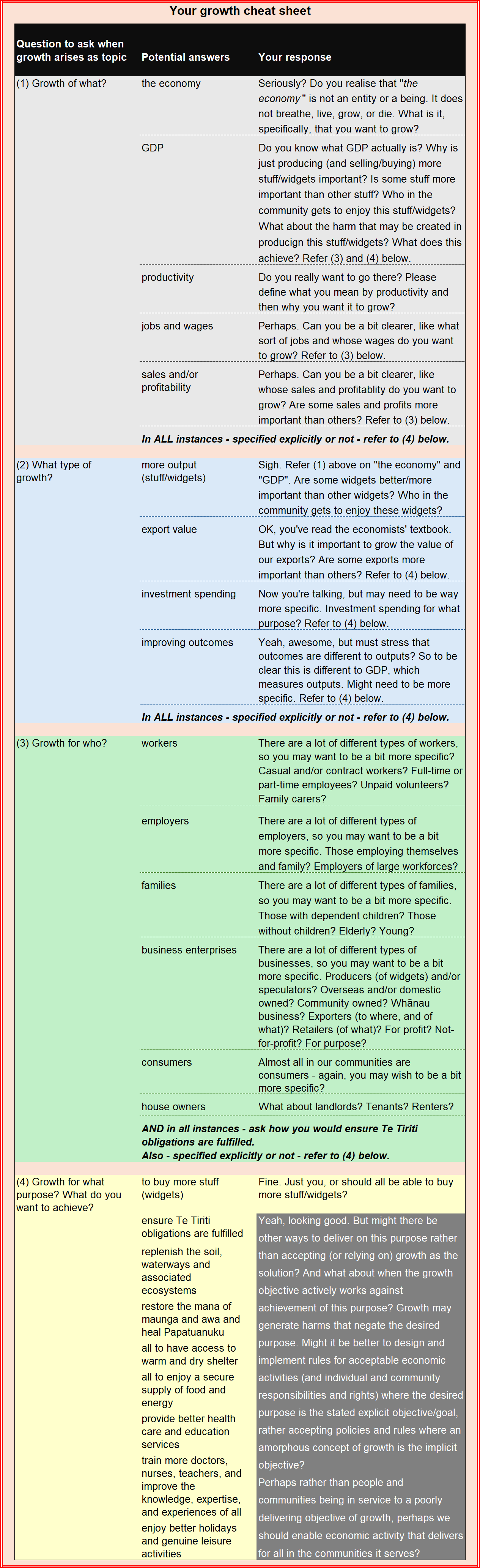
Refer to the cheat sheet below for further elaboration.
My pitch
For my pitch, I point you to several other posts of mine where I describe the purpose of the economy that we should be building, along with the rules (aka social contract) that we need to agree5.
Note importantly, I have nothing against growth - or, indeed, against degrowth. And, yes, I do follow quarterly GDP data with intense interest - primarily because I love spreadsheets. But, in the face of the results of our growth experience, I am truly agnostic as to sign (or quantum) of the latest quarterly GDP numbers. The characteristics of a successful economy, delivering for all in the communities it serves, requires more than a few quarters (or, indeed, a few years) of GDP growth (or degrowth).
Bluntly, growth is not the answer because I have no idea what the question was. Whatever growth (or degrowth) we experience, the more critical question is
how do we ensure that the economic activity we undertake is of the type that generates outcomes consistent with our desired purpose for economic activity?
In particular, we must focus clearer and cleverer on specifying the type of the growth (or degrowth) - alongside a laser focus on the distribution of the costs and benefits of growth (or degrowth) - that we wish to foster, enable, and enjoy.
A progressive party/coalition/government that openly and unapologetically sets the explicit purpose for our economy as delivering for all in the communities it serves - with distribution, re-distribution, and pre-distribution policies/interventions/programs having centre-stage billing - would get my vote.
Sadly, I’ve been waiting more than 30 years and none have got my vote. Yet!
GDP is a measure of the quantity (or output) - of goods produced and services delivered (widgets) over a period of time - of an economy. Is restricted to goods and services obtained through monetary transactions. Does not include the outputs of voluntary or unpaid work. Is seen by many as a proxy for the size of an economy. Does not capture the costs or harm incurred as a result of such activity, unless the costs or harm are imposed as a monetary charge on others active in that economy.
This is average annual percentage growth in per capita GDP. There have been some quarters (and years) of negative growth, and there have been some quarters (and years) of positive growth. Over the 40 years this growth has averaged-out at the equivalent of 1.2 percent per annum. Consequently, GDP per capita (inflation-adjusted) has risen to be $81,000 now, from the $50,000 some 40 years earlier.
Refer Welfare Expert Advisory Group Whakamana Tāngata: Restoring Dignity to Social Security in New Zealand.
For example, many projects or proposals - whether they be roads, mining, oil and gas exploration, visitor attractions, favourable tax treatment for investors, convention centres, subsidies for film makers, easing regulatory restrictions, free trade agreements, international trade exhibitions and galas et al - are justified using Business Cases and/or Benefit-Cost Ratios incorporating an estimate for the increase in GDP (or extra growth) induced.
For example, What is the economy?, Building our own sandpit, and What’s the deal?. In particular, for completeness and transparency, my contribution to the discussion about the purpose of an economy would be: to safeguard and nurture the resources that we inherited so they can be passed – fit for purpose – to coming generations.